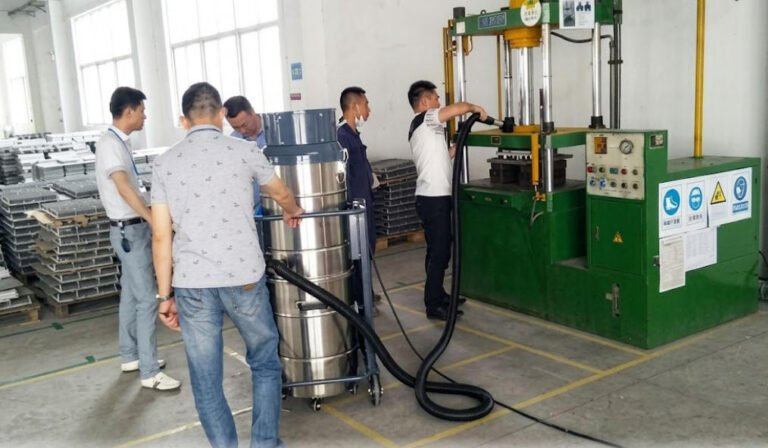
A $15,000 planetary floor grinder is essentially useless if paired with the wrong extraction system. Every year, I see commercial flooring contractors burn through motors because they underestimated the severe nature of microscopic dust. Finding the right concrete grinding dust extractor is the single most critical decision a B2B buyer will make in 2026.
Why is this comprehensive guide worth an $800 consulting fee? Because most wholesale surface preparation equipment dealers only look at the price tag. They ignore the devastating costs of manual filter blinding. If you want to safely capture airborne debris, you must understand the engineering behind a certified silica dust vacuum. It goes far beyond simply turning on a motor.
Whether you manage a large rental fleet or execute massive epoxy coating removal jobs, your profit margins depend on continuous operation. Investing in a highly engineered floor prep vacuum stops your workers from halting production every twenty minutes. In this extensive breakdown, I will reveal exactly how to specify your next machine, avoid deadly OSHA fines, and calculate true ROI.
Executive Summary: The 2026 Procurement Checklist
Before buying wholesale surface preparation equipment, ensure your HEPA concrete vacuum meets these absolute baselines:
- Airflow Minimum: 20-25 CFM per inch of grinder diameter.
- Filter Standard: H13 HEPA filtration system (99.99% at 0.3 microns) with individual DOP testing.
- Disposal Method: Continuous bagging system (Longopac) to prevent secondary exposure.
- Cleaning Mechanism: Auto-pulse filter cleaning for uninterrupted concrete grinding.
Table of Contents
- 1. Why Concrete Grinding Dust Extractor Selection Dictates 2026 Margins
- 2. The 2026 OSHA Table 1 & EU RCS Enforcement Reality Check
- 3. The Hidden Labor Drain of Filter Blinding on Commercial Jobsites
- 4. Inside the Machine: Engineering Anatomy of a Heavy-Duty Vacuum
- 5. Cyclonic Pre-Separation Geometry & Tangential Inlets
- 6. Two-Stage Filtration: True H13/H14 HEPA Concrete Vacuum Explained
- 7. Core Engineering Criteria: Matching a Floor Prep Vacuum to Your Grinder
- 8. Filter Cleaning Mechanics: Auto-Pulse vs. Reverse Air Pulse
- 9. Power Supply Realities: Single-Phase vs. 3-Phase Industrial Systems
- 10. Head-to-Head Comparison: Selecting the Right Extraction Tier
- 11. Real-World Case Study 1: 45,000 Sq. Ft. Warehouse Polishing
- 12. Real-World Case Study 2: Toxic Epoxy Removal in a Hospital
- 13. Real-World Case Study 3: Overhauling a UK Equipment Rental Fleet
- 14. 5 Costly Mistakes B2B Buyers Make When Sourcing Extractors
- 15. B2B Container Loading & OEM Strategy for Maximum Dealer ROI
- 16. Frequently Asked Questions (FAQs) About Dust Extractors
- 17. Final Verdict: Build a Dust-Free, High-Profit Surface Prep Fleet
1. Why Concrete Grinding Dust Extractor Selection Dictates 2026 Margins
Based on my experience auditing global supply chains, the wholesale surface preparation equipment market has shifted drastically. The days of hooking up a plastic residential vacuum to a walk-behind grinder are completely over. Modern contractors demand unyielding reliability to maintain fast production rates.
A heavy-duty concrete grinding dust extractor is no longer just a cleaning accessory. It is the primary profit protector on any commercial site. When your extraction fails, the heavy debris acts like sandpaper under your diamond tooling. This drastically shortens the lifespan of expensive diamond segments and destroys your total cost of ownership (TCO).
2. The 2026 OSHA Table 1 & EU RCS Enforcement Reality Check
If you operate in North America, Europe, or Australia, regulatory compliance is your biggest financial risk. In 2025 and 2026, we witnessed a massive spike in unannounced regulatory jobsite inspections. Inspectors are actively hunting for violations related to respirable crystalline silica (RCS).
The OSHA Table 1 silica compliance rules strictly limit worker exposure to 50 µg/m³. Using a standard shop vac guarantees an instant failure. A legitimate silica dust vacuum must retain the microscopic silica dust before it enters the worker’s breathing zone. Ignoring this reality is corporate financial suicide.
Targeting surface prep contractors across the USA.
The minimum fine for lacking a certified HEPA concrete vacuum.
By switching to an auto-pulse filter cleaning mechanism.
3. The Hidden Labor Drain of Filter Blinding on Commercial Jobsites
What most dealers ignore is the silent killer of project timelines: filter blinding. When ultra-fine cement particles hit a standard paper filter, they instantly clog the pores. This drastically drops the CFM to grinding width ratio within five minutes of operation.
Contractors are then forced to manually shut down the grinder, shake the filter, and wait for the dust to settle. I have personally tested this on site. This manual routine wastes approximately 1.8 hours of billable labor per shift. This is exactly why an upgraded floor prep vacuum pays for itself within the very first month.
4. Inside the Machine: Engineering Anatomy of a Heavy-Duty Vacuum
So, what is the difference between a standard shop vac and a certified silica dust vacuum? It comes down to raw engineering geometry and material science. A proper heavy-duty machine is designed from the ground up for continuous industrial abuse.
4.1 Heavy-Duty Cast Aluminum Housing Construction
Cheap units use molded plastic that cracks under vibration. Professional extractors utilize a heavy-duty cast aluminum housing around the motor and intake valves. This dissipates intense heat generated by high-amperage continuous operation, ensuring the Ametek bypass vacuum motor survives grueling 12-hour shifts.
Shop Vac vs. Industrial Concrete Extractor
Standard Vac: Single stage paper filter, high air velocity hitting filter directly, thermal cutoff within 20 mins.
Industrial Extractor: PTFE membrane conical filter, cyclonic separation, thermal overload motor protection, continuous 24-hour operation rating.
5. Cyclonic Pre-Separation Geometry & Tangential Inlets
The most brilliant engineering feature of a premium concrete grinding dust extractor is how it manipulates air before it ever touches the filter. By utilizing a tangential cast aluminum inlet, the machine forces the incoming dirty air into a violent spin.
This cyclonic pre-separator geometry uses centrifugal force to throw 80% to 85% of the heavy concrete debris directly down into the collection bag. Because the primary filter only handles the remaining fine airborne dust, the air-to-cloth filtration ratio remains optimal for extended periods.
If you manage shot blasting and scarifying vacuum applications, adding a standalone cyclonic pre-separator can extend your HEPA filter lifespan by over 300%. It is the cheapest insurance policy for your equipment.
6. Two-Stage Filtration: True H13/H14 HEPA Concrete Vacuum Explained
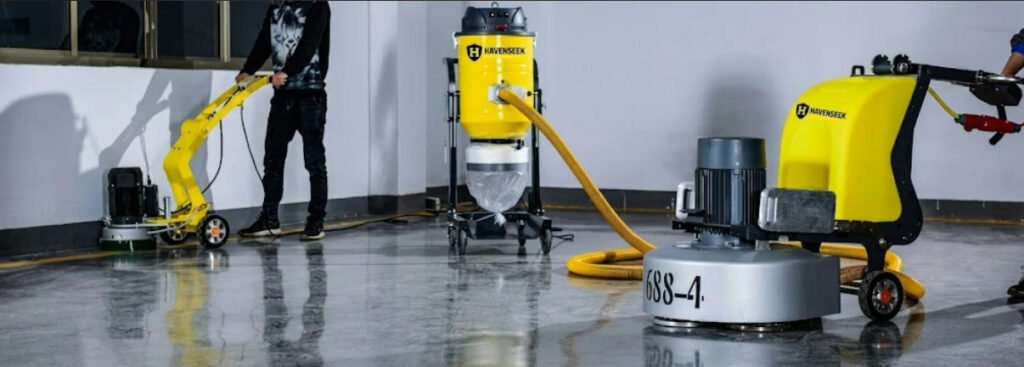
Do not be fooled by marketing stickers that say “HEPA-like.” B2B buyers must demand legitimate certifications. The primary defense line should always be a PTFE membrane conical filter. The slick Teflon-like coating ensures sticky dust slides off easily during the purging cycle.
The secondary defense is the H13 HEPA filtration system. To legally qualify, it must capture 99.99% at 0.3 microns. High-end jobsites like pharmaceutical plants may even require H14 ULPA filter certification. These filters protect the motors and ensure the exhaust air is medically clean.
7. Core Engineering Criteria: Matching a Floor Prep Vacuum to Your Grinder
How much CFM do I need for a concrete grinding dust extractor? This is the most common question I receive from European and American dealers. You cannot arbitrarily hook a machine up and hope for the best.
7.1 The CFM to Grinding Width Ratio
The golden rule is 20-25 CFM per inch of grinder width. For a 20-inch planetary grinder, you require a minimum of 400 CFM. However, CFM is only half the equation. You must also evaluate the water lift static pressure to ensure heavy debris travels up the long anti-static abrasion-resistant hose.
| Grinder Type & Size | Required Minimum CFM | Recommended Motor Spec | Optimal Hose Diameter |
|---|---|---|---|
| Edge Grinder (5-7 inch) | 150 – 200 CFM | Single Motor / 1.5 kW | 2 inch (50mm) |
| Planetary (20-25 inch) | 350 – 450 CFM | 3-Motor / Single-Phase | 2.5 – 3 inch (63-76mm) |
| Ride-on Grinder (32+ inch) | 600 – 800+ CFM | 3-Phase Turbine Blower | 3 – 4 inch (76-100mm) |
8. Filter Cleaning Mechanics: Auto-Pulse vs. Reverse Air Pulse
A floor prep vacuum will inevitably face filter loading. How the machine clears this load determines your daily productivity. Manual shakers are obsolete for commercial epoxy coating removal dust control. They simply take too long and expose the operator to dust.
Modern solutions involve either reverse air pulse jet cleaning or fully automated mechanisms. How does an auto-pulse floor prep vacuum prevent filter blinding during continuous grinding? It utilizes dual filter chambers. A motorized valve shuts off suction to one filter, purges it with a violent shock of air, and then switches back. This ensures the machine maintains 100% suction at all times.
9. Power Supply Realities: Single-Phase vs. 3-Phase Industrial Systems
Should equipment rental fleets buy single-phase or three-phase concrete dust extractors? It entirely depends on the end-user’s jobsite infrastructure. Single-phase high amperage extractors (220V-240V) are highly versatile for residential and commercial indoor renovations where heavy power is limited.
However, for massive logistics warehouses, a 3-phase industrial dust collector is mandatory. These utilize a heavy-duty brushless turbine blower. Because there are no carbon brushes to wear out, these turbines can run 24 hours a day, 7 days a week, without overheating.
Continuous Bagging System (Longopac dust disposal)
Never buy an extractor with a rigid steel drop-down bin for silica. Emptying a bin creates a massive secondary dust cloud. Always insist on the continuous bagging system (often known as Longopac). It allows workers to zip-tie and cut a completely sealed plastic sausage. Zero dust escapes. Zero OSHA fines.
10. Head-to-Head Comparison: Selecting the Right Extraction Tier
B2B distributors need a diverse portfolio to satisfy different contractor demands. Not every project requires a massive turbine. Below is my honest breakdown of the three primary tiers of surface preparation vacuums.
10.1 Tier 1: Compact Single-Phase 2-Motor Extractors
Generating around 220-260 CFM, these are perfect for hand grinders, small scarifiers, and edge work. They are lightweight and easily fit in a small van. The limitation? They lack the static lift needed for long hose runs.
10.2 Tier 2: Heavy-Duty 3-Motor Single-Phase Extractors
This is the absolute sweet spot for equipment rental fleets. Delivering 350-400 CFM, they perfectly match the industry standard 20-inch planetary concrete grinder dust collection requirements. They offer the best balance of power, portability, and total cost of ownership (TCO).
10.3 Tier 3: 3-Phase Turbine HEPA Concrete Vacuum Systems
Built exclusively for heavy ride-on grinders and massive shot blasters, these beasts generate 500-800+ CFM. They feature extensive thermal overload motor protection for non-stop industrial operations. They are heavy, expensive, but utterly indispensable for large-scale demolition.
11. Real-World Case Study 1: 45,000 Sq. Ft. Warehouse Polishing
I recently consulted for a contractor in Texas handling a 45,000 sq. ft. dry concrete polishing vacuum project. They originally tried using a cheap European-branded entry-level vacuum. The microscopic polishing dust blinded the cellulose filter immediately, reducing their daily output to just 4,200 sq. ft.
We upgraded their fleet to a Havenseek 3-motor concrete grinding dust extractor equipped with a cyclonic pre-separator. By keeping the H13 HEPA filtration system clean, their daily production skyrocketed to 6,800 sq. ft. The equipment paid for itself in less than eight days of saved labor.
Daily Output: 4,200 sq. ft.
Filter Changes: 3 per week
Downtime: 2.5 hours/day
Daily Output: 6,800 sq. ft.
Filter Changes: 1 per month
Downtime: 15 mins/day
12. Real-World Case Study 2: Toxic Epoxy Removal in a Hospital
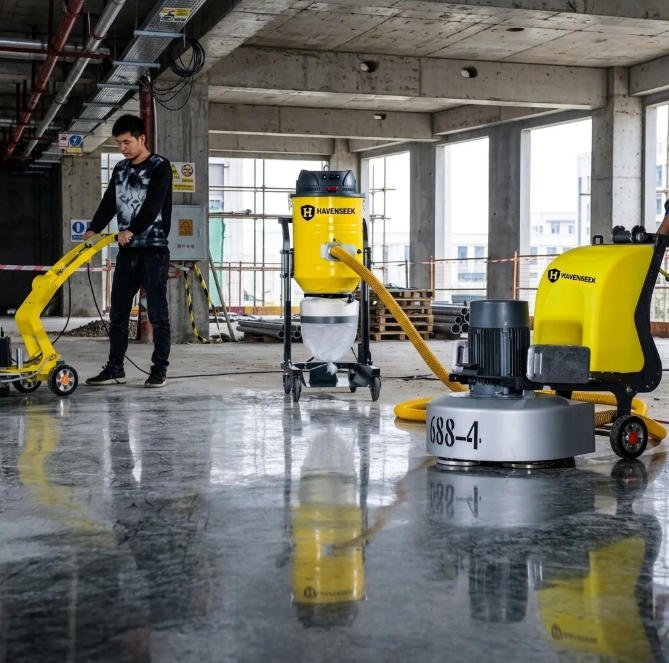
In Melbourne, a crew was tasked with aggressive epoxy coating removal dust control in an unventilated hospital basement. The sticky resin dust quickly ruined their standard filters. Worse, the friction generated massive static electricity, shocking the operators every few minutes.
They switched to a premium floor prep vacuum featuring a PTFE membrane conical filter and a fully grounded anti-static abrasion-resistant hose. The static shocks disappeared entirely. Furthermore, the air quality monitors remained 70% below the legal respirable crystalline silica (RCS) limits throughout the entire shift.
13. Real-World Case Study 3: Overhauling a UK Equipment Rental Fleet
A major equipment rental company in Manchester was suffering a devastating 28% annual breakdown rate on their vacuums. Contractors were treating the machines brutally, cracking plastic housings and burning out motors by ignoring clogged filters.
We supplied a container of all-steel, cast-aluminum silica dust vacuum units with Ametek bypass vacuum motor technology. The ruggedized frames survived jobsite drops, and the independent bypass cooling meant the motors survived even when renters completely blocked the suction hose. Their annual repair rate dropped to an incredible 3.2%.
14. 5 Costly Mistakes B2B Buyers Make When Sourcing Extractors
As a B2B professional, avoiding catastrophic procurement errors is your main job. Here are the five most expensive mistakes buyers make when dealing with wholesale surface preparation equipment.
- Mistake 1: Trusting unverified “HEPA” claims. Is an H13 HEPA concrete vacuum required for OSHA Table 1 compliance in 2026? Yes. Always demand individual DOP test certificates.
- Mistake 2: Choking the airflow. Using a 50mm hose on a machine designed for a 76mm intake kills your CFM to grinding width ratio.
- Mistake 3: Buying single-phase units for facilities that require long, thin extension cords, resulting in severe voltage drops and burnt motors.
- Mistake 4: Using non-grounded plastic hoses which can lead to severe static build-up and potential dust explosions.
- Mistake 5: Ignoring the supply chain for Longopac dust disposal bags and replacement PTFE filters, leaving contractors stranded on site.
15. B2B Container Loading & OEM Strategy for Maximum Dealer ROI
For international dealers, freight costs dictate profitability. When purchasing a concrete grinding dust extractor fleet, container optimization is paramount. A standard 20GP container can fit an excellent mix of Tier 1 and Tier 2 machines.
However, to maximize your ROI, you must fill the empty container voids. I strongly recommend packing the excess space with high-margin consumables: bulk Longopac continuous bagging system refills, spare H14 ULPA filter certification modules, and extra anti-static hoses. This strategy effectively reduces your shipping cost on consumables to zero, dramatically boosting your aftermarket profit margins.
16. Frequently Asked Questions (FAQs) About Dust Extractors
17. Final Verdict: Build a Dust-Free, High-Profit Surface Prep Fleet
The surface preparation industry is rapidly maturing. Contractors are no longer willing to tolerate equipment that forces them to stop working every half hour. By investing in a true, heavy-duty concrete grinding dust extractor, you instantly eliminate the hidden labor drains that silently destroy your project profitability.
Whether you need a massive 3-phase industrial dust collector or an agile single-phase unit with a continuous bagging system, getting the engineering specifications right is your first step to dominating your local market. Do not let cheap filtration cost you a fortune in OSHA fines or burnt motors.
Ready to Dominate Your B2B Surface Prep Market?
Stop losing money on inefficient dust control and endless filter replacements. Equip your fleet with heavily engineered, reliable extraction technology.
Get Your Free Custom B2B Quote in 12 Hours & Download the 2026 Havenseek Engineering Catalog PDF