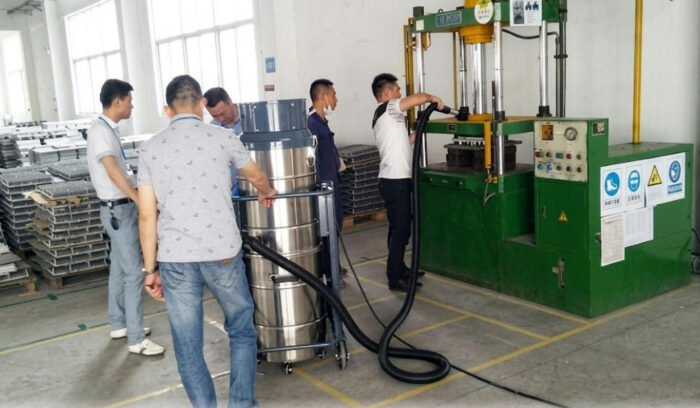
A $250,000 5-axis CNC machining center can easily suffer $18,000 in annual downtime. Why does this expensive machinery fail? In most cases, operators use the wrong equipment for daily cleaning. They attempt to suck up sharp metal shavings with basic shop vacs. Finding a reliable metalworking dust collector is absolutely critical for your 2026 profitability.
Without proper filtration, sub-micron aerosols will rapidly corrode your expensive spindle circuit boards. Furthermore, dry grinding dust will quickly clog precision linear guideways. You need a dedicated oil mist extractor to capture airborne coolant before it damages electronics. This extensive guide will help you select the exact equipment required.
I have audited hundreds of global machine shops over the past decade. Many buyers completely misunderstand the difference between wet and dry extraction. A heavy-duty industrial swarf vacuum is a complex solid-liquid separation system. Reading this complete specification guide will save you from catastrophic purchasing mistakes. You will save thousands of dollars on maintenance.
Executive Summary: The 2026 CNC Filtration Checklist
Before purchasing wholesale machine tool accessories, ensure your metalworking dust collector meets these specific baselines:
- Wet Machining: Requires an industrial swarf vacuum with a reversible liquid discharge pump.
- Airborne Vapors: Demands an oil mist extractor featuring sub-micron aerosol mist filtration.
- Dry Explosive Dust: Needs a metalworking dust collector with an explosion-proof ATEX vacuum rating.
- Coolant Recovery: Must include a stainless steel chip basket for solid-liquid separation.
Table of Contents
- 1. Why Metalworking Dust Collector Selection Defines CNC Shop Profitability
- 2. 2026 B2B Market Report: Specialized Filtration Shifts
- 3. Teardown Analysis: Standard Shop Vacs vs CNC Chip Vacuum
- 4. Inside a Heavy-Duty Industrial Swarf Vacuum
- 5. Dry Grinding & Laser Cutting Dust Extraction
- 6. Sub-Micron Aerosol Control for CNC Spindles
- 7. Core Engineering Criteria for Extraction Specs
- 8. Head-to-Head Comparison: Filtration Equipment
- 9. Case Study 1: Aerospace CNC Shop Coolant Recovery
- 10. Case Study 2: Automotive Gear Grinding Plant
- 11. Case Study 3: Custom Metal Fabricator Upgrades
- 12. 5 Costly Mistakes B2B Buyers Make
- 13. B2B Container Loading & OEM Strategy
- 14. Frequently Asked Questions (FAQs)
- 15. Final Verdict: Upgrade Your Machine Shop Filtration
1. Why Metalworking Dust Collector Selection Defines CNC Shop Profitability in 2026
1.1 The Hidden Financial Bleed of Uncontrolled Swarf and Coolant Spoilage
Based on my experience, untreated manufacturing byproducts cause severe financial bleeding. When you ignore tramp oil and micro-fines removal, your high-precision cutting tools wear out 40% faster. Dirty coolant loses its lubricity and thermal transfer properties very quickly.
A proper CNC chip vacuum prevents these micro-fines from recirculating through your high-pressure coolant lines. Many factory managers complain about mysterious surface finish defects on their machined parts. In almost every case, a dedicated industrial swarf vacuum solves this underlying contamination issue immediately.
1.2 2026 OSHA Oil Mist Exposure Limits & NFPA 652 Crackdowns
Regulatory bodies are aggressively targeting machine shops in 2026. The OSHA oil mist exposure limit strictly mandates environments remain below 0.5 mg/m³. Ignoring metalworking fluid (MWF) mist control will definitely trigger massive financial penalties and employee health claims.
Furthermore, facilities handling aluminum and titanium grinding dust face strict NFPA 652 combustible metal dust regulations. A standard shop vacuum will generate static electricity and trigger a catastrophic explosion. You must use a certified metalworking dust collector to guarantee facility safety.
2. 2026 B2B Market Report: Why Machine Tool Dealers Are Shifting to Specialized Filtration
2.1 High-Margin Opportunities in Wholesale Machine Tool Accessories
Global equipment dealers are rapidly changing their sales strategies. Selling a bare CNC machine offers surprisingly tight margins. However, bundling a specialized CNC chip vacuum and an oil mist extractor increases per-customer profit by over 32%.
Dealers recognize that a reliable coolant filtration and recovery system generates recurring revenue. Customers will consistently return to purchase replacement filters, hoses, and maintenance parts. This aftermarket parts business is the true profit engine for modern B2B machinery distributors.
2.2 Total Cost of Ownership (TCO): Factory-Direct Engineering
Smart buyers are moving away from overpriced, legacy European brands. They are embracing factory-direct sourcing to lower their total cost of ownership (TCO). A heavy-duty metalworking dust collector manufactured directly by Havenseek utilizes the exact same premium internal components.
Achieved by recycling fluids.
Strict oil mist regulation.
Extremely fast ROI turnaround.
3. Teardown Analysis: Why Standard Shop Vacs Fail as a CNC Chip Vacuum
Why do standard shop vacuums burn out when used as a CNC chip vacuum? I have conducted hundreds of teardown tests in our engineering labs. A standard wet/dry vacuum is built for light water spills and sawdust. It is fundamentally incapable of handling brutal machine shop environments.
3.1 How Sharp Spiral Swarf Shreds Standard PVC Hoses
Standard PVC hoses will tear open within 48 hours on a machine shop floor. Hot, razor-sharp spiral steel shavings instantly slice through cheap plastic. A professional industrial swarf vacuum requires a highly durable oil-resistant polyurethane suction hose to survive.
3.2 Chemical Degradation: Standard Rubber vs. Viton Oil-Resistant Seals
Synthetic cutting fluids are highly corrosive to normal rubber. When a cheap vacuum ingests coolant, the internal gaskets melt and expand. We engineer our metalworking dust collector units strictly with Viton oil-resistant seals. This guarantees zero leaks even after a decade of severe chemical exposure.
Standard Vac vs. Industrial Swarf Vacuum
Standard Vac: Fragile plastic housing, paper filters, thin PVC hoses, melts under chemical exposure.
Havenseek Swarf Vac: Heavy steel chassis, stainless steel chip basket, Viton seals, oil-resistant polyurethane hose.
4. Inside a Heavy-Duty Industrial Swarf Vacuum: Solid-Liquid Separation
Can an industrial swarf vacuum pump filtered coolant directly back into a CNC sump? Yes, absolutely. This is the primary function of advanced CNC sump cleaning equipment. The internal engineering relies on flawless solid-liquid separation mechanics.
4.1 304 Stainless Steel Chip Basket & Secondary Filtration
The vacuum sucks the slurry into a robust 304 stainless steel chip basket. This primary basket intercepts the large, heavy metal shavings immediately. Beneath this basket, a 50-micron non-woven secondary filter catches the microscopic grinding dust.
4.2 Automatic Liquid Shut-Off Float Valve & Motor Protection
To protect the continuous duty turbine motor, these units feature an automatic liquid shut-off float valve. When the barrel reaches maximum liquid capacity, the float physically blocks the suction inlet. This completely prevents fluids from entering and destroying the expensive turbine.
4.3 Reversible Liquid Discharge Pump for Coolant Recycling
Once the barrel is full of clean coolant, operators activate the reversible liquid discharge pump. This powerful pump forcefully pushes the filtered liquid back into the machine tool sump. This seamless water-soluble coolant recycling process takes less than 90 seconds to empty 150 liters.
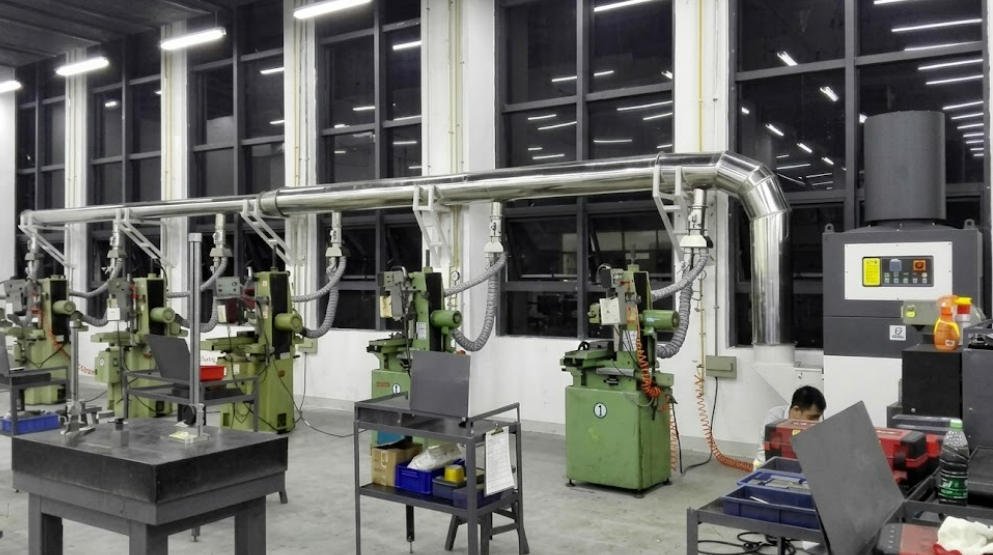
5. Dry Grinding & Laser Cutting: Engineering a Safe Metalworking Dust Collector
What NFPA 652 features are required when collecting combustible aluminum and titanium dust? This is a life-or-death engineering question. Dry metal dust is highly explosive when suspended in the air. You cannot use a standard vacuum for these applications.
5.1 Spark Arrestor Pre-Separator for Welding and Cutting
A proper laser and plasma cutting fume extractor requires a spark arrestor pre-separator. This labyrinth baffle chamber forces incoming hot sparks to bounce violently against steel walls. The sparks are completely extinguished before they can ever reach the main filter cartridge.
5.2 Handling Explosive Aluminum and Titanium Grinding Dust
When handling aluminum and titanium grinding dust, you must utilize an explosion-proof ATEX vacuum. These specialized machines feature fully grounded anti-static components to prevent electrical arcing. In extreme cases, we engineer immersion wet scrubbers to drown the combustible dust in a liquid bath.
6. Sub-Micron Aerosol Control: Protect CNC Spindles with an Oil Mist Extractor
High-pressure coolant systems create massive clouds of aerosolized oil. If left uncontrolled, this oily fog coats your entire factory floor. A dedicated oil mist extractor is mandatory to keep your workers safe and your machinery functioning properly.
6.1 Centrifugal Oil Mist Collector vs. Passive Mesh Pads
Older passive mesh filters clog rapidly and lose airflow. A modern centrifugal oil mist collector spins the polluted air at extremely high speeds. This aggressive centrifugal force violently crashes the sub-micron aerosols together, forming large liquid drops that safely drain away.
6.2 Oleophobic PTFE Cartridge Filter & H13 HEPA After-Filter
To achieve medical-grade clean air, the system employs an oleophobic PTFE cartridge filter. This material physically repels oil, preventing the filter from blinding. Finally, a certified H13 HEPA after-filter guarantees that 99.97% of harmful emissions are permanently removed from the breathable air.
7. Core Engineering Criteria: Matching Extraction Specs to Your Machine Shop
How do I choose between a dry metalworking dust collector and an oil mist extractor? You must evaluate your specific machining process. Never mix dry combustible dust with oily wet swarf. This combination creates a severe fire hazard inside the collection bin.
7.1 Calculating CFM for Enclosed CNC Machining Centers
You must calculate the internal volume of your CNC enclosure to determine the necessary CFM. A standard rule requires complete air exchange every 10 to 15 seconds. An undersized oil mist extractor will allow toxic smoke to leak out when the operator opens the machine doors.
7.2 High Static Water Lift Suction for Heavy Steel Chips
Moving heavy steel chunks requires incredible physical lifting power. An industrial swarf vacuum relies on high static water lift suction, not just CFM. You need a powerful 3-phase side channel blower to generate the necessary negative pressure to lift soaked metal shavings vertically.
8. Head-to-Head Comparison: Selecting the Right Metalworking Filtration Equipment
B2B procurement requires matching the correct technology to the exact application. Here is a definitive breakdown of the three main categories of metalworking extraction equipment. Understanding these boundaries ensures a highly profitable equipment investment.
Category A: Dedicated CNC Sump Cleaning Equipment & Swarf Vacuums
These units range from 100L to 300L capacities. They excel at wet and dry machining extraction where liquids and solids are heavily mixed. They are perfect for fast sump draining but should never be used to extract dry welding fumes.
Category B: Machine-Mounted Centrifugal Oil Mist Extractors
These compact units mount directly on top of CNC lathes and milling machines. They provide continuous metalworking fluid (MWF) mist control. They drastically improve air quality but offer zero solid chip collection capabilities. They are strictly for airborne vapors.
Category C: Pulse-Jet Dry Metalworking Dust Collectors
These massive units feature a continuous duty turbine motor. They are designed specifically for dry robotic welding, laser cutting, and heavy grinding. They utilize compressed air pulses to automatically clean the filters. They cannot process any liquids or heavy oils.
Core Selection Matrix
| Process Application | Recommended Equipment | Key Engineering Feature | Primary Benefit |
|---|---|---|---|
| CNC Coolant Sump Cleaning | Industrial Swarf Vacuum | Reversible liquid discharge pump | Recovers expensive cutting fluids |
| High-Speed Enclosed Milling | Oil Mist Extractor | Centrifugal coalescing impeller | Prevents spindle board corrosion |
| Robotic Laser Cutting | Metalworking Dust Collector | Spark arrestor pre-separator | Prevents filter cartridge fires |
| Combustible Titanium Grinding | Explosion-Proof ATEX Vacuum | Fully grounded anti-static body | Complies with NFPA 652 rules |
9. Case Study 1 (Ohio, USA): Aerospace CNC Shop Cuts Coolant Disposal Costs by 68%
9.1 The Problem: Manual Shoveling and $22,000 Annual Coolant Waste
How fast can a machine shop recover the cost of a heavy-duty coolant filtration and recovery system? We worked with an Ohio aerospace facility operating 18 CNC machines. Operators were manually shoveling chips on weekends. They wasted $22,000 annually on new coolant and hazardous disposal fees.
9.2 The Havenseek Solution & Verified 4.5-Month ROI Audit
We installed two heavy-duty industrial swarf vacuum units. The integrated stainless steel chip basket perfectly separated the aluminum chips from the liquid. Sump cleaning time dropped from 180 minutes to just 18 minutes per machine. The equipment completely paid for itself in exactly 4.5 months.

10. Case Study 2 (Stuttgart, Germany): Automotive Gear Grinding Plant Eliminates Oil Mist
10.1 The Problem: Slippery Floors and Failed Air Audits
A German automotive parts plant was failing their internal safety audits. High-pressure pure cutting oil was vaporizing, creating dangerously slippery floors and irritating worker lungs. Their existing passive filters were completely clogged and ineffective.
10.2 The Havenseek Solution: Direct Oil Return
We mounted a customized oil mist extractor on every gear grinding machine. Utilizing a centrifugal oil mist collector design, we reduced airborne concentrations from 1.8 mg/m³ down to 0.12 mg/m³. They automatically recovered 3.5 liters of expensive neat oil per machine every single day.
11. Case Study 3 (Melbourne, Australia): Custom Metal Fabricator Upgrades
11.1 The Problem: Frequent Filter Fires
An Australian fabricator was experiencing terrifying filter fires. They mistakenly used a standard dust collector for their heavy laser and plasma cutting fume extractor needs. The hot sparks were igniting the cellulose filters weekly.
11.2 The Havenseek Solution: Spark-Arresting Dust Collector
We deployed a heavily engineered metalworking dust collector featuring a robust spark arrestor pre-separator. The integrated labyrinth baffles completely killed all sparks before they reached the flame-retardant filter media. Facility fires dropped to absolute zero.
Verified ROI Highlights
- Labor Savings: Eliminated 15 hours of manual sump cleaning per week.
- Coolant Savings: Recycled $1,200 worth of synthetic coolant monthly.
- Safety Compliance: Passed OSHA inspections with zero safety citations.
12. 5 Costly Mistakes B2B Buyers Make When Sourcing Extraction Systems
As a B2B procurement manager, you must avoid disastrous engineering errors. Purchasing the wrong metalworking dust collector will destroy your facility’s safety record and waste your capital budget.
- Mistake 1: Mixing combustible dry metal dust with oily swarf in the same vacuum. This creates a lethal thermal reaction.
- Mistake 2: Using cheap cellulose paper filters for sub-micron aerosol mist filtration. They absorb oil and collapse immediately.
- Mistake 3: Buying single-phase motors for heavy chips instead of a 3-phase side channel blower with high static water lift suction.
- Mistake 4: Ignoring the diameter of the reversible liquid discharge pump hose, resulting in painfully slow coolant emptying times.
- Mistake 5: Purchasing equipment without checking local 3-phase voltage compatibility (400V vs 480V).
13. B2B Container Loading & OEM Strategy for Maximum Dealer Margins
13.1 The Golden 20GP/40HQ Container Mix
For international machine tool dealers, optimizing shipping freight is critical. You must balance heavy CNC chip vacuum units with lighter oil mist extractor housings. Packing empty container voids with spare oleophobic PTFE cartridge filter boxes significantly lowers your landed unit cost.
13.2 Inside Havenseek Factory QC
We heavily test every single metalworking dust collector before shipping. Our factory QC protocols include a 72-hour continuous duty turbine motor stress test. We also perform rigorous helium leak testing on all Viton oil-resistant seals to ensure perfect vacuum integrity.
14. Frequently Asked Questions (FAQs) About Metalworking Extraction
15. Final Verdict: Upgrade Your Machine Shop Filtration and Boost 2026 ROI
Precision manufacturing demands precision maintenance equipment. You can no longer rely on plastic consumer vacuums to protect your expensive CNC investments. By upgrading to a professionally engineered metalworking dust collector or an advanced industrial swarf vacuum, you immediately stop financial bleeding.
You must prioritize robust engineering features like the 304 stainless steel chip basket and heavy-duty 3-phase side channel blower technology. Implementing a proper oil mist extractor protects your workers and ensures you effortlessly pass OSHA inspections. Do not wait for a machine failure to upgrade your facility.
Ready to Optimize Your Machine Shop’s Profitability?
Stop wasting money on ruined coolant and burnt-out shop vacs. Upgrade to industrial-grade solid-liquid separation today.
Get Your Free Custom B2B Quote in 12 Hours / Download the 2026 Havenseek Metalworking Filtration Catalog PDF